

Comment choisir sa première montre automatique : le guide selon votre profil
Acheter une montre automatique, c’est bien plus qu’un simple achat : c’est un passage symbolique. C’est découvrir un objet qui vit, bat et vieillit avec vous, une mécanique de précision qui traverse le temps sans jamais dépendre d’une pile.
Mais alors, comment bien choisir sa montre automatique ?
Entre les mouvements, les tailles, les styles et les marques, le choix peut vite devenir complexe. Pourtant, quelques principes simples permettent de trouver la bonne :
- Définir son usage : port quotidien, travail, sport ou occasions spéciales ?
- Choisir un mouvement fiable : japonais (Miyota, Seiko), suisse (Sellita, ETA) ou chinois (Seagull).
- Trouver le bon style : sportif, habillé, minimaliste ou technique.
- Adapter la taille à son poignet : 39 à 42 mm pour un confort optimal.
- Penser long terme : une montre automatique bien entretenue dure toute une vie.
Chez Maison du Temps, nous croyons qu’une montre se choisit autant avec le cœur qu’avec la raison. Elle doit refléter votre personnalité et accompagner chaque instant sans jamais se démoder. Dans ce guide, nous allons vous aider à comprendre les fondamentaux de la montre automatique, et surtout à identifier le modèle qui vous correspond vraiment selon votre profil : que vous soyez curieux, esthète, passionné de mécanique, sportif ou collectionneur en devenir.
Définir les bons critères avant d’acheter sa première montre automatique
Lorsqu’on achète sa première montre automatique, on se laisse souvent guider par l’esthétique, la marque ou le prix. Pourtant, ces éléments ne suffisent pas à garantir un bon choix. Une belle montre peut se révéler décevante si elle n’est pas confortable, trop lourde, ou simplement disproportionnée au poignet. Avant de se laisser séduire, il est donc essentiel de comprendre les critères qui comptent vraiment. Ce sont eux qui feront la différence entre un achat impulsif et une pièce que l’on aura plaisir à porter pendant des années.
Les critères fondamentaux à considérer
- La marque : elle rassure, mais ne dit pas tout. Mieux vaut privilégier une jeune maison qui accorde de l’importance au choix de ses composants et à la qualité d’assemblage à l’instar de MaisonDuTemps plutôt qu’un logo prestigieux au détriment du contenu mécanique.
- La qualité des matériaux : l’acier inoxydable 316L, un verre minéral ou saphir, et un bracelet bien ajusté assurent robustesse et confort. Ces détails techniques garantissent la longévité de votre montre.
La taille du boîtier : le critère le plus souvent mal choisi
C’est l’un des pièges les plus fréquents pour un premier achat. Une montre trop grande écrase le poignet et perd toute élégance ; une montre trop petite paraît disproportionnée et manque de présence. La bonne taille, c’est celle qui se fond naturellement dans votre gestuelle et épouse votre morphologie sans contrainte.
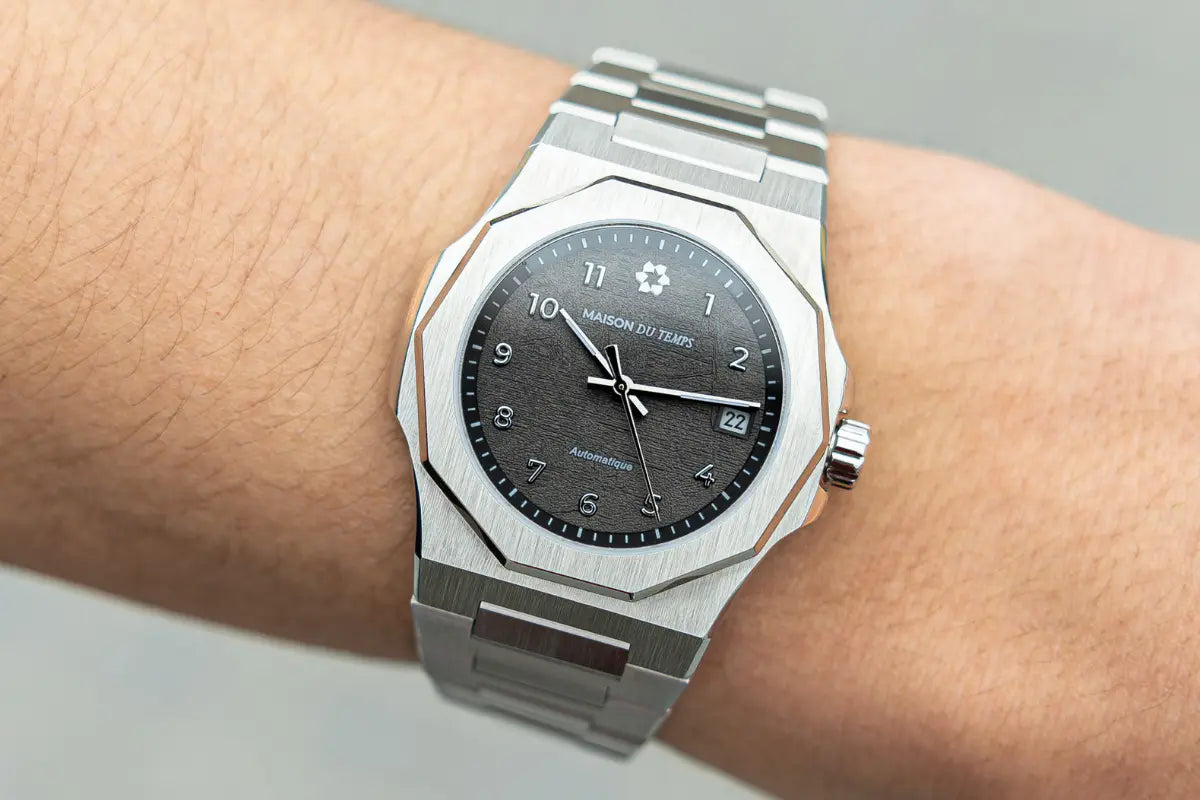
En règle générale, un diamètre compris entre 39 et 42 millimètres convient à la majorité des poignets masculins. Les poignets fins gagneront en équilibre avec un boîtier plus contenu, autour de 38 à 40 mm, tandis que les poignets plus larges supporteront sans peine 42 à 44 mm. Mais au-delà des chiffres, c’est le ressenti qui prime : la montre doit sembler faire partie de vous, ni pesante, ni encombrante.
Une erreur de taille est souvent ce qui conduit à délaisser une montre pourtant superbe. Chez Maison du Temps, nous accordons une attention particulière à cet équilibre. Nos modèles sont pensés pour offrir une présence affirmée mais toujours harmonieuse, quelle que soit la morphologie du poignet.
Choisir une montre automatique, c’est apprendre à observer ces détails. Ce sont eux qui transforment un bel objet en une pièce personnelle et durable. Le bon mouvement, la bonne taille, le bon confort : voilà les fondations d’un premier achat réussi, celui qui donnera envie d’aller plus loin dans la découverte du temps mécanique.
Comprendre ce qu’est une montre automatique avant de la choisir
Avant de parler de style, de prix ou de marque, il faut d’abord savoir ce que l’on achète vraiment. Beaucoup d’acheteurs confondent montre automatique, mécanique et quartz, alors que tout part de là : comprendre le fonctionnement d’une montre automatique, c’est comprendre ce qui justifie son prix, sa fiabilité et son charme particulier. C’est aussi ce qui permet d’éviter les erreurs les plus fréquentes lors d’un premier achat.
Une montre vivante, animée par le mouvement du poignet
Une montre automatique est une montre mécanique qui fonctionne sans pile. Elle se remonte seule grâce aux mouvements naturels du poignet : chaque geste active un rotor interne qui recharge un ressort, emmagasinant ainsi l’énergie nécessaire pour faire tourner les aiguilles. Autrement dit, c’est une montre vivante, qui puise son énergie dans le rythme de celui qui la porte.
Un héritage horloger entre tradition et innovation
Ce principe d’auto-remontage, inventé au XVIIIe siècle et perfectionné au XXe, a profondément transformé la manière de concevoir la mesure du temps. Contrairement aux montres à quartz, qui dépendent d’une batterie électronique, la montre automatique repose sur un mécanisme entièrement mécanique : un ensemble d’engrenages, de ressorts et de rouages d’une précision fascinante.
Ce ballet millimétré est souvent visible à travers un fond transparent, où le rotor tourne au gré des mouvements du poignet. Cette transparence n’est pas seulement esthétique : elle exprime la beauté du geste et la maîtrise du savoir-faire horloger.
Le symbole d’un art du temps différent
Au-delà de la technique, la montre automatique représente une certaine philosophie. Elle incarne la rencontre entre la rigueur de l’ingénierie et la poésie du temps qui passe. Elle séduit autant les passionnés d’horlogerie que les amateurs de beaux objets, car elle ne se contente pas de donner l’heure : elle raconte une histoire, celle du lien entre l’homme et la mécanique.
Posséder une montre automatique, c’est renouer avec une forme de lenteur assumée, un retour à l’essentiel et à la beauté du mouvement perpétuel. C’est aussi un plaisir presque méditatif : observer l’aiguille glisser sans à-coups, sentir le poids de l’acier, écouter le battement discret du mécanisme.
Un choix durable et émotionnel à la fois
Enfin, une montre automatique se distingue par sa longévité. Bien entretenue, elle peut fonctionner plusieurs décennies, parfois même être transmise de génération en génération. C’est cette durabilité, alliée à la noblesse du mouvement, qui en fait un choix à la fois rationnel et profondément émotionnel.
Acheter une montre automatique, c’est finalement faire le choix d’un objet qui ne se contente pas de mesurer le temps, mais qui l’accompagne une mécanique qui continue de battre tant que l’on continue de vivre.
Comprendre le fonctionnement d’une montre automatique, c’est saisir son âme et son intérêt. Mais avant de passer à l’achat, encore faut-il savoir ce qui fait réellement la différence entre un bon modèle et un simple bel objet. C’est là que les critères de choix entrent en jeu.
Les critères essentiels avant d’acheter sa montre automatique
| Critère | Pourquoi c’est important | Ce qu’il faut viser |
|---|---|---|
| Mouvement | Détermine la fiabilité et la précision | Mouvements japonais (Miyota, Seiko) ou suisses (Sellita, ETA) |
| Taille du boîtier | Influence le confort et l’équilibre visuel | 39 à 42 mm pour un poignet moyen |
| Style | Fait écho à votre personnalité | Sportif, habillé, minimaliste ou technique |
| Bracelet | Impacte le confort et la durabilité | Silicone ou acier |
| Entretien | Gage de longévité | Révision tous les 4 à 6 ans |
Inspirez-vous de ceux qui ont trouvé leur première montre automatique
Chaque amateur d’horlogerie a une histoire différente. Certains tombent amoureux d’un cadran au hasard d’une vitrine, d’autres cherchent un modèle précis depuis des mois. Et puis il y a ceux qui ne s’y connaissaient pas du tout, mais qui ont eu un coup de cœur pour une montre qui leur ressemblait.
Chez Maison du Temps, nous voyons chaque jour ces premiers achats se transformer en véritables découvertes.
Paul a choisi une montre automatique simple et fiable pour célébrer sa première promotion. Julie voulait un modèle élégant, assez discret pour le travail, mais assez affirmé pour les soirées. Karim, passionné de mécanique, a passé des heures à observer le mouvement de sa montre à travers le fond transparent.
Tous ont trouvé dans leur montre plus qu’un accessoire : une façon de se reconnecter au temps, à eux-mêmes, et à la beauté du geste.
Comprendre les critères techniques, c’est une chose. Mais le vrai choix d’une montre automatique ne se résume pas à une fiche technique : il dépend aussi d’un style de vie, d’une émotion, d’une envie. Car une montre ne se choisit pas seulement pour ce qu’elle est, mais pour ce qu’elle dit de vous.
Pour vous aider à mieux vous projeter, nous avons imaginé plusieurs exemples inspirés de ceux qui ont franchi ce pas : des hommes et des femmes qui, comme vous, ont cherché leur première montre automatique et ont trouvé celle qui correspondait à leur façon de vivre le temps.
Le Curieux : découvrir l’automatique sans se ruiner
Paul, 28 ans, voulait une montre mécanique “pour voir la différence”. Il ne connaissait pas grand-chose à l’horlogerie, mais voulait comprendre cette sensation unique : sentir la montre vivre au rythme de son poignet. Son objectif ? Trouver un modèle simple, fiable et accessible, capable de l’accompagner chaque jour sans contrainte.
Pour un premier achat, il a privilégié un mouvement japonais Miyota — reconnu pour sa robustesse — et un design polyvalent, à mi-chemin entre sport et élégance. C’est souvent le bon réflexe pour débuter : choisir une montre intuitive, bien équilibrée et facile à porter en toute occasion.
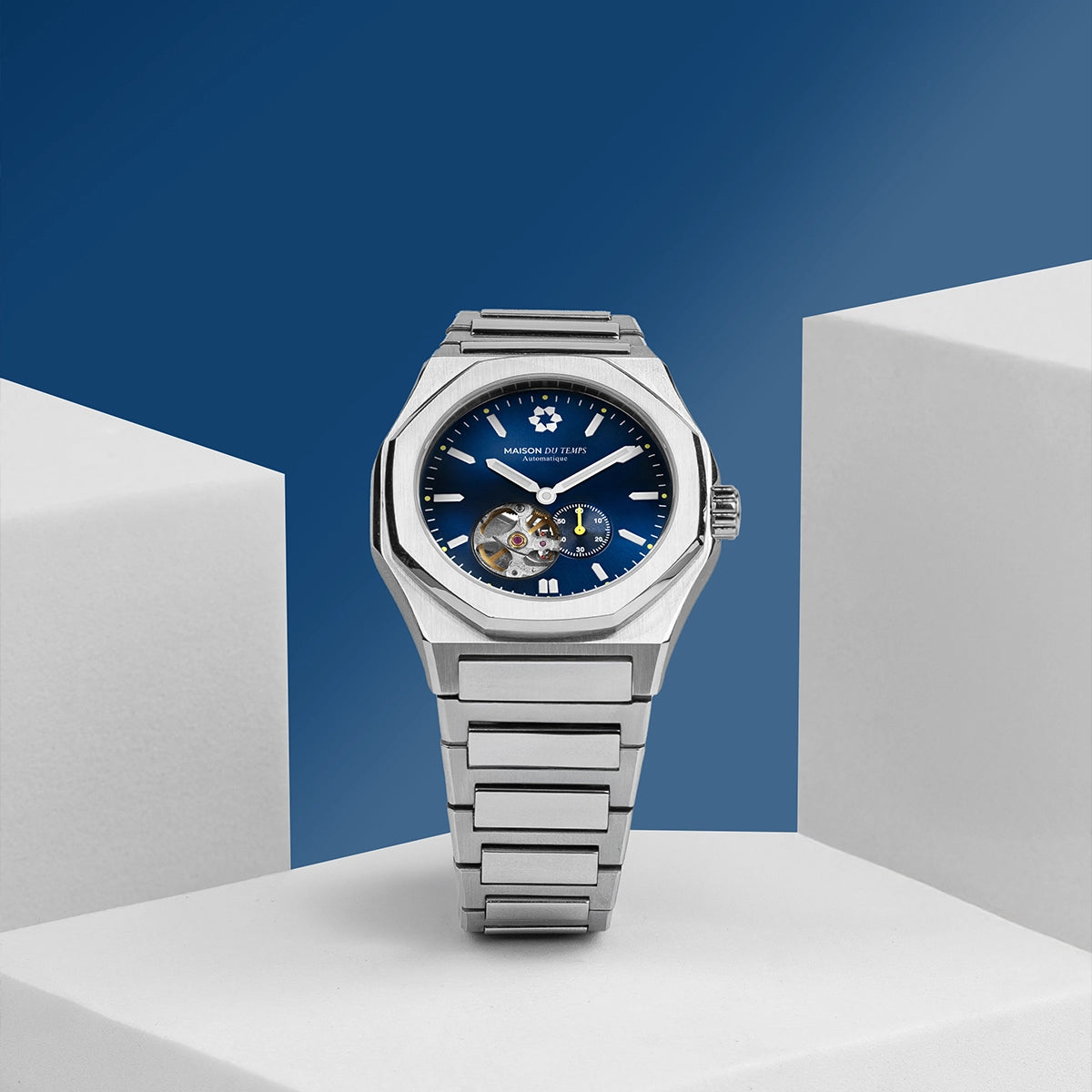
Recommandation Maison du Temps : MTBeta Skeleton Silicone Bleu
Une montre automatique accessible et rassurante, parfaite pour faire ses premiers pas dans la mécanique du temps.
L’Esthète : la montre comme signature de style
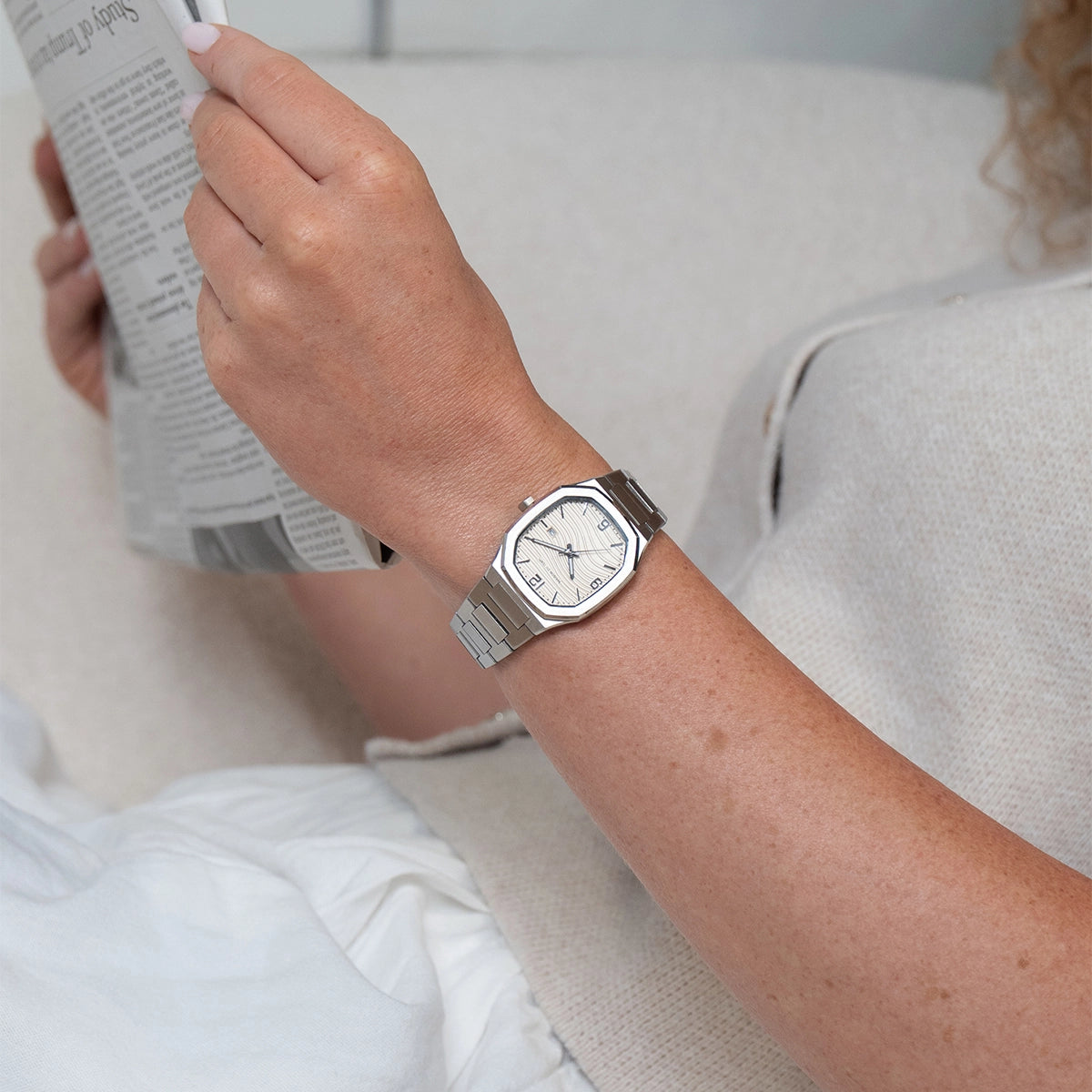
Julie, 32 ans, cherchait une montre automatique comme on cherche un bijou. Pas pour la technique, mais pour l’allure. Elle voulait une pièce qu’elle puisse porter aussi bien avec une chemise blanche qu’un tailleur, et qui attire le regard sans jamais être ostentatoire.
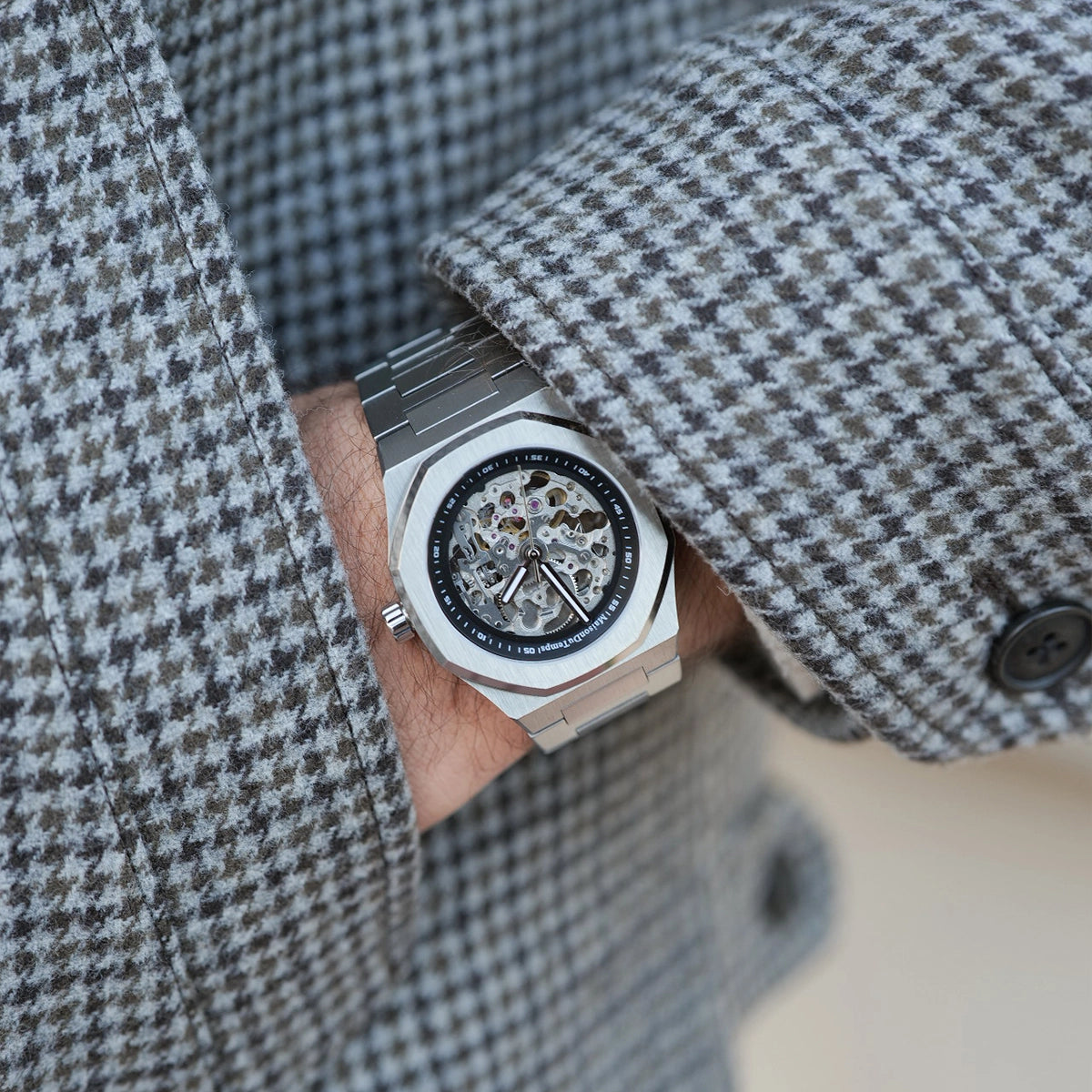
Pour elle, le choix du cadran et des finitions est primordial : une montre doit refléter une élégance naturelle, un sens du détail. Les modèles ajourés ou aux lignes sobres sont souvent les plus justes : ils mettent en valeur la personnalité sans la travestir.
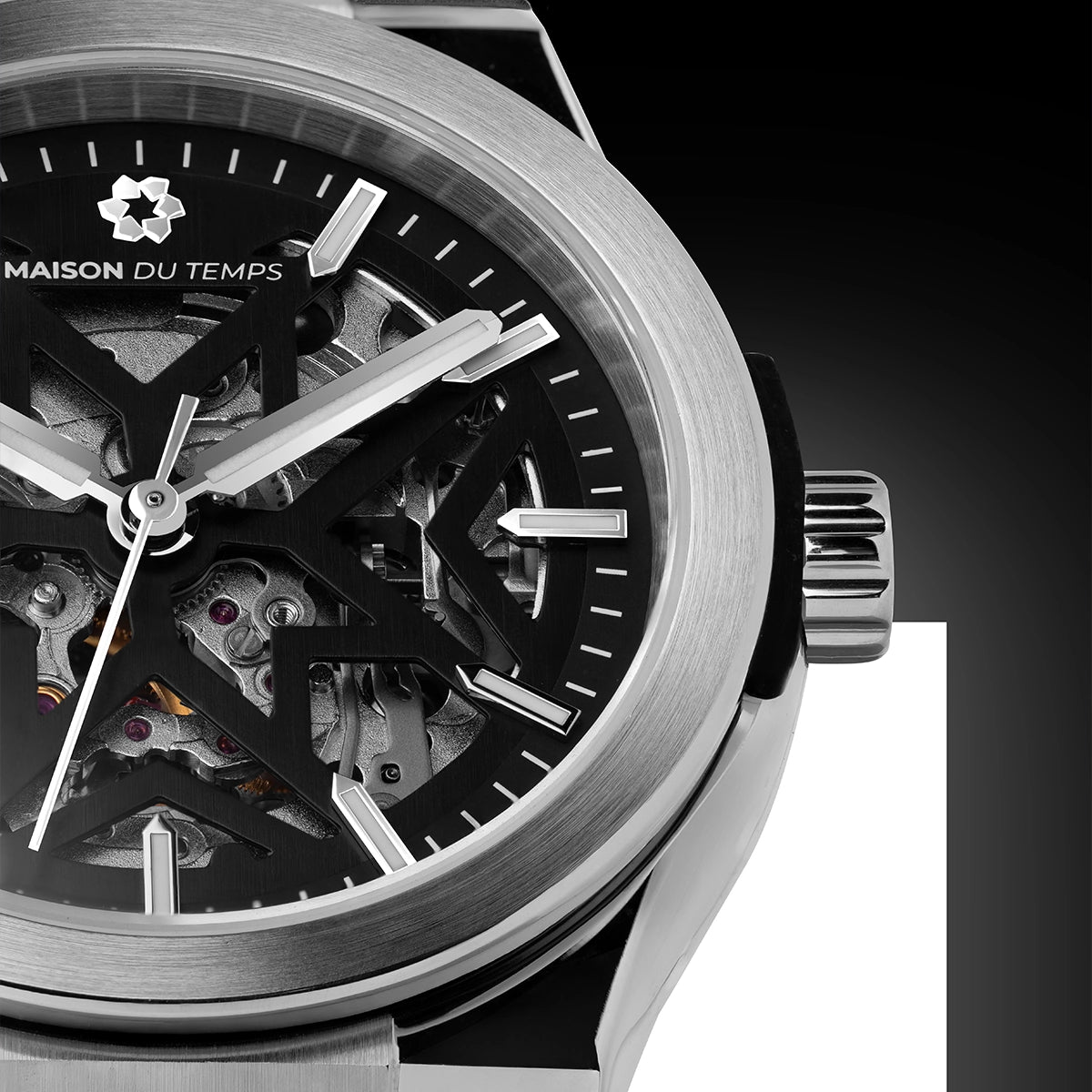
Recommandation Maison du Temps : MTBeta Skeleton Black edition Acier. Une montre à la fois sobre et expressive, où le mouvement s’affiche comme un élément de design.
Le Passionné de mécanique : fasciné par le mouvement
Karim, 35 ans, s’est intéressé à l’horlogerie pour sa beauté technique. Ce qu’il aime, ce n’est pas seulement porter une montre : c’est observer son cœur battre. Il passe des heures à regarder le rotor tourner, à écouter le tic-tac régulier du mouvement, à comprendre comment chaque pièce interagit avec la suivante.
Les montres skeleton sont faites pour lui. Elles révèlent la précision du mouvement et la poésie de l’ingénierie. Pour un passionné, le plaisir réside dans cette transparence : porter une montre, c’est aussi contempler le temps en action.
Recommandation Maison du Temps : MTBeta Skeleton Silicone Rouge .Un modèle à cadran ouvert, technique et expressif, pensé pour ceux qui aiment comprendre le temps.
Le Sportif : la montre comme partenaire du quotidien
Lucas, 29 ans, ne voulait pas d’une montre de collection, mais d’un compagnon de tous les jours. Une montre solide, qu’il puisse garder au poignet pendant une séance de sport, un déplacement professionnel ou un week-end improvisé. Il cherchait un modèle à la fois confortable, résistant et élégant.
Pour lui, le bon choix repose sur la robustesse : un boîtier acier, une étanchéité d’au moins 5 ATM, un bracelet silicone agréable à porter. Ce type de montre doit supporter le rythme du quotidien sans jamais perdre son éclat.
Recommandation Maison du Temps : MTBeta Skeleton Silicone Bleu. Une montre automatique robuste et élégante, pensée pour ceux qui vivent intensément leurs journées.
Le Collectionneur en devenir : une montre pour commencer une histoire
Adrien, 40 ans, n’a pas acheté sa première montre automatique pour l’heure qu’elle donne, mais pour l’histoire qu’elle raconte. Il voulait une pièce capable de durer, de vieillir avec lui, et peut-être même d’être transmise un jour. Son choix s’est naturellement porté sur une montre à la personnalité forte, au mouvement éprouvé, à la fois classique et moderne.
Le collectionneur débutant cherche souvent une montre symbolique, une pièce de référence qui servira de base à une future collection. C’est une démarche passionnée, presque initiatique : commencer avec une montre que l’on aime vraiment, et non avec celle que la tendance dicte.
Recommandation Maison du Temps : MTBeta Skeleton Black Edition Acier Un garde-temps à l’équilibre parfait, entre tradition horlogère et design contemporain.
Découvrir son profil aide à comprendre ce que l’on recherche dans une montre : un style, un usage, une émotion. Mais même avec les meilleures intentions, certains choix peuvent conduire à la déception. Les montres automatiques sont des objets précis, sensibles, faits pour durer à condition d’éviter quelques erreurs fréquentes qui, malheureusement, gâchent souvent la première expérience horlogère.
Avant de passer à l’achat, prenons un instant pour passer en revue les cinq pièges les plus courants que rencontrent ceux qui découvrent l’univers de l’automatique.
Les erreurs à éviter avant d’acheter sa première montre automatique
Acheter sa première montre automatique est souvent un moment d’enthousiasme, parfois d’impatience. On veut se faire plaisir, on cherche à bien faire, mais il suffit de quelques approximations pour choisir un modèle qui ne correspond pas vraiment à ses attentes. Voici les cinq erreurs les plus fréquentes — et comment les éviter.
1. Se fier uniquement à la marque
C’est la tentation la plus répandue. Les grandes marques inspirent confiance, mais un nom ne garantit pas toujours la qualité du mouvement. Certaines maisons misent davantage sur le design ou la notoriété que sur la précision mécanique.
Le bon réflexe : intéressez-vous d’abord au cœur de la montre — le mouvement. C’est lui qui en détermine la valeur réelle. Chez Maison du Temps, nous avons fait le choix du mouvement japonais Miyota pour sa robustesse et sa fiabilité, éprouvées depuis des décennies.
2. Ignorer la taille du poignet
Une montre trop grande ou trop épaisse déséquilibre immédiatement le poignet et perd en élégance. À l’inverse, un modèle trop petit semble perdu et manque de présence. La taille du boîtier est un critère essentiel, souvent sous-estimé.
Le bon réflexe : essayez toujours une montre avant de l’acheter, ou mesurez précisément votre poignet. En général, un diamètre de 39 à 42 mm offre un équilibre idéal pour un usage quotidien. L’important n’est pas la taille “tendance”, mais celle qui vous va naturellement.
3. Négliger l’entretien
Une montre automatique n’est pas un objet figé : c’est une mécanique vivante. Comme toute machine de précision, elle nécessite un entretien régulier pour préserver sa justesse et sa durabilité.
Le bon réflexe : prévoyez une révision complète tous les cinq à six ans, et nettoyez régulièrement le boîtier et le bracelet. Un entretien préventif coûte peu, mais prolonge considérablement la vie de la montre. Une montre bien entretenue peut traverser plusieurs générations.
4. Oublier le confort
Beaucoup se focalisent sur l’esthétique et négligent le confort. Une montre inconfortable finit toujours par être laissée de côté, quelle que soit sa beauté. Le poids, la souplesse du bracelet et la forme des cornes jouent un rôle déterminant dans le plaisir de port.
Le bon réflexe : optez pour un bracelet bien ajusté, ni trop serré ni trop lâche. Les bracelets silicone ou acier bien finis offrent un excellent compromis entre élégance et confort. Une montre réussie se fait oublier au poignet.
5. Penser que toutes les montres automatiques se valent
Sous une apparence similaire, deux montres automatiques peuvent être radicalement différentes. La précision, la qualité des composants, la finition des aiguilles ou du cadran varient énormément d’un modèle à l’autre.
Le bon réflexe : apprenez à reconnaître les signes de qualité : un mouvement connu, un boîtier en acier 316L, une étanchéité maîtrisée, un fond transparent bien assemblé. Le regard s’éduque vite : plus vous observez, mieux vous choisissez.
Une fois ces erreurs évitées, le choix devient plus clair, plus intuitif. On ne regarde plus seulement une montre : on comprend ce qu’elle représente, comment elle fonctionne, pourquoi elle nous attire. C’est à ce moment-là qu’on ne cherche plus une montre automatique, mais sa montre automatique. Chez Maison du Temps, c’est précisément cette expérience que nous souhaitons offrir : une rencontre entre la précision d’un mouvement, l’élégance d’un design et la personnalité de celui qui la porte.
Redécouvrir le temps à travers une montre automatique
Choisir sa première montre automatique, c’est bien plus qu’un achat : c’est un engagement. Un geste qui relie la modernité à la tradition, la précision à l’émotion. C’est la découverte d’un objet qui ne se contente pas de donner l’heure, mais qui vit avec vous, s’anime à chacun de vos mouvements et traverse les années sans perdre son éclat.
Une montre automatique, lorsqu’elle est bien choisie, devient un repère intime. Elle accompagne les moments importants, marque les réussites, se transmet parfois comme un témoin silencieux du temps qui passe. Elle vous relie à quelque chose de plus grand : le plaisir du geste, la beauté du mouvement, la maîtrise du temps.
Chez Maison du Temps, cette philosophie guide chacune de nos créations. Nos montres automatiques allient la rigueur mécanique du mouvement japonais Miyota, la finesse d’un design français et la promesse d’un confort durable. Pensées pour durer, elles incarnent une manière d’être au monde : libre, élégante et intemporelle.
Votre première montre automatique n’est pas un simple accessoire : c’est un point de départ. Celui d’une passion, d’une histoire, d’un lien avec le temps que vous choisirez désormais de porter au poignet.
Découvrir la collection de montres automatiques Maison du Temps